skip to main |
skip to sidebar
 34 seconds. That's all it took for the Hindenburg, the greatest airship in the history of Hydrogen-fueled aviation to explode into flame, sink to the ground and change the world. 34 seconds from the first fire on the tail to the epic crash-landing. What's more, it all happened next door - at the Lakehurst, New Jersey Naval Airforce Station, about 90 minutes from NYC. The good volunteers at the Navy Lakehurst Historical Society provides tours free of charge to interested citizens, only on the second Saturday of the month, only at 9:30 in the morning, and only if all attendees provide their home address and social security numbers two weeks in advance. It is an active Naval Airbase after all.
 We couldn't possibly pass up such a geek-a-licious historical adventure, even if, two weekends ago, it was pissing rain like Heaven's plumbing had gone haywire. Off to Joisey! Three cars from three different parts of Brooklyn took off for Lakehurst - the Levy boys plus Alisa car; the Eggplant Xpress carrying yours truly, friends Josh & Jenene, and yours' trulys' lovely new girlfriend Emily; and the roommate car with Steve and GF Zan. After swimming our way south on the Garden State Pkway we arrived at the Airbase and on our way into disaster-history!
 The Hindenburg was built between 1931 and 1936 in Friedrichshafen, Germany. 803.8 feet long and 135.1 feet wide in diameter - which is roughly the length of an 80 story building. When fully inflated, she carried approx. 7 million cubic feet of hydrogen in 16 separate cells; this allowed for easier inflation. The German government paid for the Hindenburg's construction; therefore, enormous swastikas painted onto her tail and fin. Her cabins included a piano room, a reading room, a dining room and a smoking room (which utilized pressurized gases, neutralizing the hydrogen.) Her trip to the States on May 6th, 1937 was the first of 10 scheduled trips kicking off the '37 airship season.
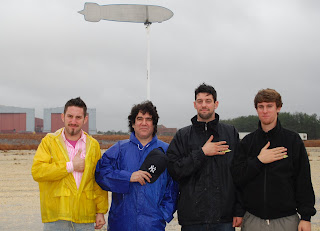
 Our guide, a well informed volunteer and former navy man Donald Adams, led our caravan onto the wide open field where the Hindenburg went down; we approached a somber airship-shaped memorial complete with historical bronze plaque. There was also a rough hand-painted little Hindenburg on a post, flapping in the tough winds. Donald gave us hard facts - the Hindenburg hovered approx 300 feet in the air, mooring lines out and down and waiting for mooring. This was when (most reports claim) the static electricity in the atmosphere (or a lightning strike) coupled with the wet weather made a deadly combo for the airship, which was venting hydrogen in order to land. Oxygen + Hydrogen = extremely combustible; within 34 seconds, it was all over.
 We also learned that the legendary Oh the Humanity! newscast with Herbert Morrison was recorded at a slightly slower speed, so in the sped-up real-time version, his naturally sonorous voice seems high-pitched & charged with extra emotion. What's more, the newsreel wasn't broadcast until the next day out of Chicago, and no-one heard it live unless they were present at the crash. Out of 36 passengers and 61 crew, 13 passengers and 22 crew members died, plus one ground crewman. Two survivors are still alive, including then-14-year-old cabin boy Werner Franz.
 Following a lot of snapshots, we made our way into the hangar and airship museum. Along with scale models of the Hindenburg there were relics and pieces from the wreckage. We bought some souvenirs (Hindenburg coffee mug! Naval Air force Base jacket patch!) and made our way into the hangar, large enough to fit two Hindenburg airships side-by-side with 12 feet of clearance. This double-airship hangar is the largest in the country and one of only two in the world. Hidden within the hangar was another museum, filled with model airplanes, ships and jets as well as walls upon walls of Navy, Air force and Army patches, all of which were supremely awesome.
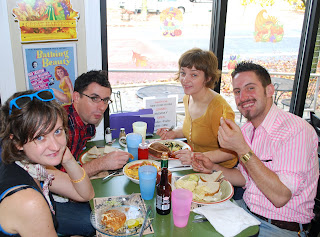 All of this disaster and naval history and air force patches and old men flying model airplanes made us pretty hungry, so off to a Joisey diner we went! Although most of us had our hearts set on a classic stainless steel, Formica counter, burgers / grilled cheese / meatloaf style joint, but instead we settled at a quaint, cute little cafe in downtown Lakehurst. Good food, but the attitude and atmosphere was top notch thanks to the owner, a former local Bronx boy (he and Dad Levy both attended the same high school!) After some homemade ice cream from the parlor next door, we piled back into our vehicles and called it a historical disastery day.
 In our last Lost in History, we discussed why Congressman Anthony Weiner’s proposal to reopen the Statue of Liberty’s Crown and viewing station is a poor idea. To recap, she’s a fire and safety hazard, and any minor malady suffered by an unsuspecting tourist would have enormous and unfortunate ramifications on the multitudes standing in a three-hour line to get to her head. But little attention is paid to the Statue of Liberty’s torch and its viewing platform, and there’s a good reason for that.
Yes indeed, the torch at the tippy-top of the beautiful Statue of Liberty (official name: Liberty Enlightening the World) once had a viewing station, which was basically a circular walkway surrounding the torch and provided spectacular views of the harbor, the skyline and the Atlantic Ocean. Three hundred and one feet up with nothing surrounding you can be a pretty phenomenal experience, and a fellow tour guide friend who shall rename nameless once flirted her way up there with a fellow Parks Service employee. They snuck up at sunrise because he thought he was gonna get lucky. (Did he? No way.)
When the Statue opened to the public in 1886, anybody could head up to the crown. The way up to the torch was only open by special request for dignitaries (although all sorts of people abused this privilege) via a rickety ladder that ran up the length of the armature. With so many pedestrians going up and coming down, the various nuts and bolts in the armature fell loose and the structure weakened. Then came the Black Tom Island Explosion of July 30th, 1916.
 Black Tom Island used to exist in New Jersey’s harbor, at the southern point of Liberty State Park. It ceased being an island just before the start of the first World War, once the Lehigh Valley Railroad Company, which owned the pier and the island, connected it by landfill to the rest of Jersey. The island got its name from a black fisherman named (surprise!) Tom, who lived on the island in the 1800s. By the 1910s, the island was being used as an ammunitions depot, supplying the Allied powers with shrapnel, black powder, TNT and dynamite. And in the early morning of July 30th 1916, the various barges tied up at the island, carrying (by some estimates) over 2 million pounds of ammo, were set alight. The residents of Jersey City were rocked by a series of ginormous explosions — shrapnel hit the Statue of Liberty, windows were blown out in Times Square and repercussions were felt as far away as Philly. No one could ever ascertain the official cause of the explosion — whether it was a security lapse on the part of the guards, a “spontaneous combustion” event, or German sabotage. The only person accused of the event was Michael Kristoff , a 23 year old Slovak immigrant; it was said he accepted $500 in exchange for starting the small fires that rocked Black Tom off the map. He died in a peasant and was buried in a potter’s field in Staten Island, without ever admitting to the crime.
 When the island blew up, it blew out all the nuts and bolts in the Statue of Liberty’s arm, and caused $100,000 worth of damager ($1.9 million today) to her infrastructure. The War Department (which had owned and cared for Miss Liberty since 1901) used the explosion as an excuse to close down the Torch to the public, citing terrorism concerns. This is fascinating: the very same thing happened post-9/11. The National Parks Service was looking for reasons to close the Statue to the public, but the outcry would have been too great. So after 9/11 happened, the NPS said “Whoa! Terrorism! No more go up in here.” (We’re paraphrasing, but yeah, that’s basically what happened.) So, Congressman Weiner we implore you: Don’t open that crown!
 34 seconds. That's all it took for the Hindenburg, the greatest airship in the history of Hydrogen-fueled aviation to explode into flame, sink to the ground and change the world. 34 seconds from the first fire on the tail to the epic crash-landing. What's more, it all happened next door - at the Lakehurst, New Jersey Naval Airforce Station, about 90 minutes from NYC. The good volunteers at the Navy Lakehurst Historical Society provides tours free of charge to interested citizens, only on the second Saturday of the month, only at 9:30 in the morning, and only if all attendees provide their home address and social security numbers two weeks in advance. It is an active Naval Airbase after all.
 We couldn't possibly pass up such a geek-a-licious historical adventure, even if, two weekends ago, it was pissing rain like Heaven's plumbing had gone haywire. Off to Joisey! Three cars from three different parts of Brooklyn took off for Lakehurst - the Levy boys plus Alisa car; the Eggplant Xpress carrying yours truly, friends Josh & Jenene, and yours' trulys' lovely new girlfriend Emily; and the roommate car with Steve and GF Zan. After swimming our way south on the Garden State Pkway we arrived at the Airbase and on our way into disaster-history!
 The Hindenburg was built between 1931 and 1936 in Friedrichshafen, Germany. 803.8 feet long and 135.1 feet wide in diameter - which is roughly the length of an 80 story building. When fully inflated, she carried approx. 7 million cubic feet of hydrogen in 16 separate cells; this allowed for easier inflation. The German government paid for the Hindenburg's construction; therefore, enormous swastikas painted onto her tail and fin. Her cabins included a piano room, a reading room, a dining room and a smoking room (which utilized pressurized gases, neutralizing the hydrogen.) Her trip to the States on May 6th, 1937 was the first of 10 scheduled trips kicking off the '37 airship season.
 Our guide, a well informed volunteer and former navy man Donald Adams, led our caravan onto the wide open field where the Hindenburg went down; we approached a somber airship-shaped memorial complete with historical bronze plaque. There was also a rough hand-painted little Hindenburg on a post, flapping in the tough winds. Donald gave us hard facts - the Hindenburg hovered approx 300 feet in the air, mooring lines out and down and waiting for mooring. This was when (most reports claim) the static electricity in the atmosphere (or a lightning strike) coupled with the wet weather made a deadly combo for the airship, which was venting hydrogen in order to land. Oxygen + Hydrogen = extremely combustible; within 34 seconds, it was all over.
 We also learned that the legendary Oh the Humanity! newscast with Herbert Morrison was recorded at a slightly slower speed, so in the sped-up real-time version, his naturally sonorous voice seems high-pitched & charged with extra emotion. What's more, the newsreel wasn't broadcast until the next day out of Chicago, and no-one heard it live unless they were present at the crash. Out of 36 passengers and 61 crew, 13 passengers and 22 crew members died, plus one ground crewman. Two survivors are still alive, including then-14-year-old cabin boy Werner Franz.
 Following a lot of snapshots, we made our way into the hangar and airship museum. Along with scale models of the Hindenburg there were relics and pieces from the wreckage. We bought some souvenirs (Hindenburg coffee mug! Naval Air force Base jacket patch!) and made our way into the hangar, large enough to fit two Hindenburg airships side-by-side with 12 feet of clearance. This double-airship hangar is the largest in the country and one of only two in the world. Hidden within the hangar was another museum, filled with model airplanes, ships and jets as well as walls upon walls of Navy, Air force and Army patches, all of which were supremely awesome.
 All of this disaster and naval history and air force patches and old men flying model airplanes made us pretty hungry, so off to a Joisey diner we went! Although most of us had our hearts set on a classic stainless steel, Formica counter, burgers / grilled cheese / meatloaf style joint, but instead we settled at a quaint, cute little cafe in downtown Lakehurst. Good food, but the attitude and atmosphere was top notch thanks to the owner, a former local Bronx boy (he and Dad Levy both attended the same high school!) After some homemade ice cream from the parlor next door, we piled back into our vehicles and called it a historical disastery day.


 Posts
Posts


