skip to main |
skip to sidebar
 On the corner of Onderdonk and Harman streets in southern Ridgewood lies a church façade. As spelled out bilingually on purple canvas, the previous occupant of this space was the Christian Center Sanctuary of Hope, a Roman Catholic Latino congregation. The new occupants of the space are also called the Christian Center Sanctuary of Hope, but with an entirely different bend to their professed spirituality. There hasn’t been a straight-up religious sermon in the Center for years, but this past Saturday night, a different kind of sermon was held, spiritual in nature but preaching art and aesthetics, noise and performance, and the very strange story of a very famous artist and his attempts to buy oddly shaped lots at tax auctions in NYC.
 We know the backstory because we are friends with the occupants of the Christian Center Sanctuary of Hope, and they asked us to emcee the evening’s events. The good men who live at the Sanctuary — three literary and visual artists by the names of Matthew Blair, Lech Szporer and Andrew Wingert — have built lofts and incorporated the layout of the former church into a communal performance space. They opened on Saturday with a Revival that featured installation art, sculptures, music, tap dance, mime, an exercise bike that masturbated a man in a lazy chair, feedback noise, preaching, and a mysterious excursion that led to a former piece by the aforementioned very famous NYC artist. Lesser known (but no less serious) artists included yours truly, along with David Button, Trevor Lukert, Superman’s Guestlist, Marisa Mickelberg, Issac Zal, the Buddy Hollyco$t, Amery Kessler, Carrie Fox, Shana Paleologos, Andrew Hurst, Phillip Battikha, Ryan Brown, and Justin Horne. And of course, Gordon Matta-Clark.
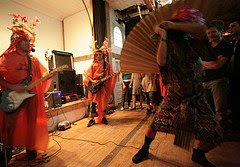 Matta-Clark was not present at the opening — he died in 1978, at the age of 35, of pancreatic cancer. During his short but powerful life he was known for various artistic experiments and performances as well as for catalyzing SoHo as an artistic neighborhood during the derelict 70s. His works, called “anarchitecture”, involved removing pieces and slivers of buildings before they met the wrecking ball; he opened a restaurant/ongoing performance piece in SoHo called Food, staffed entirely by working artists; he also purchased tiny, unusable slivers called “gutterspace” of NYC real estate during the city’s regular purging of such lots. Due to surveying, zoning and public-works anomalies, various infinitesimal slices of real estate came to be owned by Matta-Clark, who found in them a perfect bureaucratic extension of his own anarchitecture. Fourteen lots were located in Queens and one in Staten Island. Unfortunately, Matta-Clark passed away before he could do whatever he was intending to do with these lots, and the ownership passed over to his wife, who eventually stopped paying taxes on them; control reverted back to the city. One of these lots — Lot 116 — is walking distance from the Christian Center Sanctuary of Hope, and the evening’s high point included a walk to the Lot, and a sermon about separate spaces.
 As the preacher-on-site, we weren’t all that prepared for the crowd of 100 artists, gallery fags, rockers, intellectuals, confused locals, friends and family. We also didn’t know that much about Matta-Clark, or how to talk about this sliver space —2’3” wide by 355’ long – in order to make it applicable to the crowds and the evening’s events. We eventually focused on the relationship between this sliver space and the rest of the alley, and how it reflects the separate spaces inside each of us, and how they relate to the rest of us. It was complicated. Whiskey fueled most of the preaching. But it was intense. We had a few Amens! and Hallelujahs! Afterwards, when the crowd had calmed down, we all returned to the church to continue that perennial method of moving with the spirit — we had a dance party.
 We here at Lost in History delight in adventures within the outer boroughs. Especially when said adventures take us to places we haven’t been before; little known secret gardens and hardly-visited museums that revel in the urban idiosyncrasies that make NYC such a marvelous place to live and work. What better excuse to forge such an excursion then being asked to do exactly that: run an all-day adventure to parts unknown, courtesy of Flux Factory! Which is exactly what happened this past Saturday.
 Flux Factory is an arts space with a sense of humor located in Long Island City, Queens. Previous installations have included Grizzly Proof – a multimedia show involving various artists’ interpretations of a Grizzly-Bear-Proof suit; and NY NY NY – another multimedia show in which artists recreated the Queens Panorama of the City of New York, and which your author engaged the masses in a psycho-geographical trivia. For their current show, Going Places (Doing Stuff), Flux was taking the project outside, by asking various artist-performers to invent their own adventure, stuff a buncha people onto a cheese bus without revealing too much of the ensuing journey, and take off. Flux asked yours truly to kick the summer-long series off, and informed the participants that the tour would a) stay within the five boroughs, b) last all day, and c) be led by a native New Yorker and licensed NYC tour guide with “knowledge of New York City and a rambunctious personality (that) make him the greatest guide you could wish for.” Aw shucks.
 25 people met up at the City Reliquary Museum and Civic Organization in Williamsburg at half-past 11am, to peruse the museums holdings before the adventure began. Flux had been smart enough to ensure that our cheese bus had A/C so we wouldn’t swelter, and our driver was a very friendly Haitian gentleman named Marcus. As soon as we hit the BQE westbound, it was pretty clear where we were going – not to the Bronx or Manhattan or Queens. And although we were driving through Brooklyn, we sure weren’t going to spend our time there. We were headed to NY’s smallest borough in population (less than half-a-mil) but the 6th largest island off the coast of the country; the one, the only, the 40% Italian – Staten Island!
 First stop on our magical mystery tour was the Our Lady of Mt. Carmel Grotto, in Rosebank, right near the VZ Bridge. Built in 1937 by the local fraternal order, the Grotto is a handmade collaged and stucco’d outdoor sculpture built from concrete, seashells, bicycle reflectors, religious statues and ceramic chips, dedicated to their namesake saint. Open year-round, the Grotto in Rosebank is quite powerful, and as a work of handmade, devoted, religious art, it is also the first Traditional Cultural Property listed in NY State.
 Second stop was the Castleton Hill Moravian Church Labyrinth, farther inland on Victory Boulevard. Contrary to what many people think, a labyrinth is not a giant three-dimensional walled-in maze designed to lose its travelers. Instead, a labyrinth is a flattened two-dimensional path that, through it many twists and turns, will always present a way out. This particular one was laid out on the courtyard of the Church, and acts as a meditation tool; as one walks the labyrinth, one should experience peace and spiritual enlightenment. While various members of our adventuresome group strove for those lofty goals, by taking their turns in the 90-degree heat, assisted by the very friendly Pastor Lynnette Delbridge, other intrepid SI explorers marched down the block to order a half-dozen pies from the legendary Joe and Pats Pizzeria. Ricotta with broccoli rabe; Pepperoni; Scungilli with fresh garlic; cheese-free with arugula with cherry tomatoes and onions; plain; those Staten Islanders sure know how to craft heaven into eight slices loaded with fresh toppings.
 We voraciously attacked our pizza back on the bus and headed off to adventure number three, deep in the heart of the island atop Lighthouse Hill – arguably the highest natural point on the Eastern Seaboard (although this is a long-running argument between the residents of Lighthouse Hill and the residents of Todt Hill). Amidst the opulent mansions and private driveways snaking up and down the gorgeous land lies the Jacques Marchais Museum of Tibetan Art. A publicly funded institution with as idiosyncratic a history as its location, the entire place deserves its own Lost in History column, and will receive one, in due time. However, there’s more adventure to our Staten Island, so after a 45 minute docent-led tour of the tiered gardens and art & antiquities collection, we headed off.
 Rumor has it that there is a privately designed, privately owned Frank Lloyd Wright house atop Lighthouse Hill. I had never heard of such a thing until Moe, another tour guide and New-York-ophile, inquired of Jessica, the docent. She obliges and gives walking directions, so off we march through the lush SI forest to find the thing. In the midst of the hunt it begins to downpour, but Marcus, ever-ready at the helm of the cheese bus, picks us up and we manage to find the home. It looks like a Maine summer house at the edge of a lake, but one that got left in a medieval stretcher a bit too long.
 We also discover the Victorian lighthouse that gives the Hill its moniker – the towering monstrosity is just chilling in another privately owned backyard.
 The adventure is almost over – adventurers are getting Staten-Islanded-out. We attempt to find the Conference House, which is in Tottenville at the absolutely southern-most point of NY State. On Sept 11th, 1776, this country estate, the only surviving pre-Revolutionary manor house, acted as the final meeting place between the American and British Forces in a futile attempt to call off the War. Unfortunately, thanks to a series of dead-ends, and a busload of hungry, sun-stroked, tired, cranky, non-islanders, we said screw it, and made our way to Killmeyers Bavarian Beer Hall and Garden – the oldest beer hall cum restaurant in the borough. It was there that we feasted on schnitzel, bratwurst, hefeweizen, German Chocolate Cake, and raised a collective toast to the amazing, underappreciated, overlooked and friggin enormous Staten Island. And it only took two hours to get back to Brooklyn. I’d do it again in a heartbeat, but not for aother couple of years. I love you Staten Island!
 more pictures can be found here on my Flickr page.
 On Thursday we attended a free NYC Department of Parks & Recreation lecture in Columbus Park, Chinatown, featuring historian Warren Shaw, an excitable New Yorker who seemed to be even more excited that his lecture, linking the old Gangs of New York culture to the culture of today, was taking place on the physical spot where it all happened. Geek-o-licious! But this is a city filled with geeks, especially ones who love their city history, so the newly renovated Columbus Park pavilion was filled to capacity with about 60 New Yorkers who were all ears and eyes on Mr. Shaw’s PowerPoint discussion.
Titled Bums, Slummers and Swells: The Birth of American Popular Culture on the Lower East Side, 1825-1855, the lecture argued that the youth culture of the notorious Five Points neighborhood had a enormous impact on the development of urban street culture, and therefore all of American culture.
The Lower East Side of the day (what would today be roughly everything from Chatham Square to 14th Street, and from the East River to Broadway) was a crime-ridden cesspool, filled with degradation, sin and vice, squalor and disease, Catholics, Blacks, Irish and the working class. But it was also a colorful neighborhood, with local fraternity organizations sporting DIY uniforms and spouting dialects unheard of in other parts of American or the world. There was a forced camaraderie here unseen anywhere else — because although the Irish and the Blacks didn’t necessarily like each other, they were destitute, so they didn’t have much of a choice, and had to live together. This made the old Five Points the first racially integrated neighborhood in the country, as well as the densest.
Mr. Shaw pointed out that with the opening of the Erie Canal in 1825, connecting the Great Lakes and the Midwest to the Atlantic Ocean, this architectural and engineering marvel cemented New York as the capital of America’s shipping empire. Now grains, livestock, timber and everything else the bountiful Midwest had to export could be sent abroad; the Erie Canal also allowed New York City’s cultural customs and fashions, slang and dance, drinking, drugging, and colorful fighting to be spread to populated areas west of the Hudson. There was no cultural locus point for the country, as there was no common dialect. Now, along with dictating the countries’ economic trade, NYC was mastering the cultural trade as well.
Another interesting point that Mr. Shaw effusively described was the “flash talk” or slang of the gangs. Just as a member of the Crips today wouldn’t want to be caught slinging Bloods slang, the various gangs had their own vernacular, some of which survives today. “Kicking the bucket” and “Coppers” are two of the slang phrases that stick with us today, invented back in the old Five Points. ("Kicking the bucket" was how one helped an enemy off himself, by knocking the victim unconscious, stringing up a suicide noose, tossing the bozo on top of a bucket and through the loop, then kicking aforementioned bucket to leave ‘em dangling. A "Copper" was exactly that — a copper badge worn by volunteer cops, and therefore hardly intimidating or worth any respect.) Along with flash talk, the Gangs had their invented heroes, their larger-than-life characters who were inspirational figures to anyone looking to rise out of the slums. For the youth of the day, it was Mose, a tough-talkin, wise-crackin’, no-nonsense Irish B’hoy (slang for Bowery Boy) with a heart of gold. Mose can certainly be seen in various heroes of today, including Bugs Bunny, Holden Caulfield, Superman, and (this was a stretch, but) RZA of the Wu-Tang Clan.
All in all it was an interesting, exciting, geektastic lecture, not just because the words were happening on the block where these figures fought, drank, drugged, loved, danced and invented American street culture. Even though, as King of the NYC Geeks, we knew most of what Mr. Shaw was extrapolating, regardless it was wonderful to see so many other people geeking out with us.
(originally published on 6/9/8 in www.thelmagazine.com)
 It’s a safe assumption that many New Yorkers have never been to Washington Heights. Tucked up far away at the northern-most end of Manhattan, accessible by the A, C and 1 trains, Washington Heights has for the past 40 years been one of the few immigrant enclaves in Manhattan that still sees hardworking, lofty-dreaming, high-strivers arrive monthly. Chinatown in Lower Manhattan is the another such hustling and bustling ‘hood (and your urban journalist’s favorite Manhattan neighborhood) — but Chinatown’s never seen the lights of Broadway. With the arrival of the incredible new musical In The Heights, which we had the pleasure of seeing last week, it’s time to tell the vibrant story of this north side ‘nabe — both historically and through song and dance.
The “Washington” in Washington Heights is Fort Washington (the “Washington” in Fort Washington is General George), which once occupied the highest point on the island, making it a natural defense line against the Brits during the Revolutionary War. The Fort was constructed by the Continental Army and almost immediately seized by the British during the Battle of Fort Washington on November 16th, 1776; the site of the Fort is now a park, Bennett Park, just north of the George Washington Bridge. As the Industrial Age gave way to the Gilded Age, Washington Heights became popular amongst the monied crowd because of the spectacular views on the high ridge along the Hudson. When the IRT Broadway line reached the southern edge of the hood in 1904, it brought immigrants, mostly Greek and Irish, with the Jews were soon to follow. Along with the working classes came major organizations, such as the Columbia-Presbyterian Medical Center, museums and scholastic institutions at Audubon Terrace and Yeshiva University.
As is always the story in 1960s, 70s and 80s New York City, out flowed the Jews and Irish, in came the black and Latino communities; in particular, Washington Heights became the go-to neighborhood for the surging Dominican population. There were Cubans, Puerto Ricans and Mexicans moving in as well, but throughout the 1980s, no other area in the city attracted more people from the DR than Washington Heights — it was the largest DR community in the country and substantially larger than the Dominican Republic itself. Racial strife was prevalent throughout these decades, and in order to give these NY citizens a more substantial voice on the City Council, the district lines were redrawn in 1991; the same year, Guillermo Linares became the first elected official of Dominican heritage in the country.
That’s the past to Washington Heights. The present is reflected in the phenomenal In The Heights. Conceived by 28-year-old wunderkind Lin-Manuel Miranda, who wrote the lyrics and music to most of the show as a sophomore at Wesleyan University seven years ago, In The Heights is the standard immigrant striving story of trying to make it in an unforgiving city, surrounded by the people you love. The twists and turns that it takes in the interim are aided by the supernova energy of the young cast and the hyperkinetic choreography that reflects modern break-dancing, hispanic meringue, classic Jerome Robbins-style dancing and standard street moves. The songs, a powerhouse charge of salsa, hip-hop, power pop, American Idol-style solos and Broadway group numbers had one woman in the audience screaming out her passion as if she were at a concert. Upon walking out of the theater I felt revitalized and energized, that I had just seen the new face of the modern Broadway musical. And best of all, it’s a new New York musical. In The Heights is a lock for the TONY for Best Musical (who else is going to take it? Xanadu!?). And it’s about time that more of ethnic NYC got its turn on the big stage.
(originally published on 6/2/8 on www.thelmagazine.com)
 Hooray for Bicycle Fetish Day! Hooray for the City Reliquary! Boo for 5 stitches over two lacerations in one's right (that is to say: typing & writing) hand. Boo for a suspension of posts on ActionDirection blog. Lets show some pretty pictures and briefly explain a) Bike Fetish Day and b) how I ended up with abovementioned stitches.
A) Bike Fetish Day is the single largest community event the City Reliquary hosts all year. It's a day long celebration of bike culture and events, and we have a block party, where local bike gangs ride their tricked-out and bedecked two wheelers:
 Where we have a blazin Bar-B-Que:

Where I acted as the MC for a bunch of great and goofy bike awards, like Ugliest Bike, Smallest Two Wheeler, Most Tricked Out Bike, Best in Show, etc etc.

We also had the Rude Mechanical Orchestra, a politico-radical-marching-band perform, as well as a Brazilian Drum Core group.

It was an overall blast. Maybe 250-300 people showed up, ate watermelon, rode their bikes, boogied to the DJs Stacher and Dirtyfinger, and it is generally surmised that everyone had a glorious time. I also agreed to host and manage the after-party, in the CR's backyard. Most of the other Reliquarians wanted no part in the party, but BFU Marin Tockman agreed to bartend. Here's where disaster strikes.
B) As I'm stocking an ice cooler with beer for the party, I shove a bottle into the cooler with too much force and it explodes in my hand. Blood everywhere. Dave, CR Prez wraps a gauze pad around the gaping slashes in my palm and we call the ambulance. The EMTs determine I need stitches and its best to get them done now. Here's my bloody claw in the ambulance. Note the arrow indicating the damage.
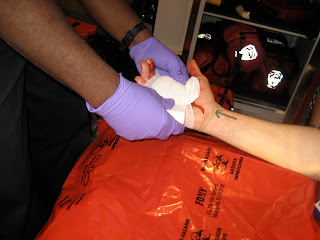
I might be all smiles in this picture (and the snazziest dressed mofo at Woodhull hospital),
 but the ensuing evening, in which I missed the party I was supposed to host, was spectacularly depressing. 2 hours in the ER, another 2 in the Triage Unit, watching a mounting battle of empty threats between two alkies (druggies? possiblys.) who were screaming in their respective English and Spanish, that they were going to fucking kill each other. No matter that the one speaking English didnt understand a word of Spanish; no matter that the one speaking Spanish couldnt comprehend a word of English; regardless, these two screwshits were hollering muerte y puta de madre and all sorts of angry mania directly from the mouths of two men, knocked clear out of the ballpark I dont even think they came to the hospital together. All I wanted was for my hand to get stitched and to crawl into a cab, back to my pad.
Which, 4 hours after strolling into the joint, finally occured. 3 stitches in the top gash, two smaller in the lower, and frustrated, angered, infuriated and depressed, i got the holy hell out of there. Marin and other reliable sources say the party was lowkey but cool, and i didnt miss much. What I missed was the whole thing - the party I was hosting for my museum. But now I can tell people I got into a bar fight with a beer bottle, however it wasnt a bar, but a Community Museum, and it wasnt a fight with another patron, but a battle with the bottle.
The hand's all better now (you can see the scar right under the index finger if you squint),
 but for the last few weeks it was too stressful to type or write, as too much flexing of the index and mid fingers have caused pain and frustration. Thanks to all who helped me through the night and ensuing weeks.
 Spring is finally swinging its gorgeous pendulum ever closer to our neck-napes: Warm breezes, shorts, and slathered sunscreen all prove that the median temperature, along with people’s flirtation levels, is on the rise. Another certain indicator of spring springing eternal is the Cherry Blossom Festival at our beloved Brooklyn Botanic Garden, a perennial favorite amongst romantics, botanists, horticulturists, New Yorkers and tourists alike. The peak cherry blossom moment just hit on Sunday, and with the largest collection of cherry blossoms in the world outside of Japan, the BBG was the place to be.
Founded in 1910, the Brooklyn Botanic Garden was established on an ash dump, sandwiched in between the Brooklyn Museum, originally called the Brooklyn Institute of Arts & Sciences, and Prospect Park. It was intended to be the green, outdoorsy compartment to a top-notch museum. (The BIAS was supposed to be the largest single museum complex in the world, with an unsurpassed collection of art, natural history and science objects. The Great Consolidation of 1898 put an end to all that.) Although hardly the first botanical gardens in the city — the first one in the country was founded in 1801 on land that would become Rockefeller Center — the Bot (as we native Brooklynites like to call it) was developed over the beginning of the 20th century and “became known for its emphasis on plant physiology and genetics and for its efforts in public education: the world’s first children’s gardening program was established in 1914.” (Per the Encyclopedia of New York City.) Dr. Charles Stuart Gager was the main man responsible for the development of the Bot, especially its beloved Japanese Hill-and-Pond Garden, which was the first Japanese garden to be landscaped in an American public gardens — in 1915, by immigrant Takeo Shiota. The cherry blossom trees, although not within the original confines of the Japanese Hill-and-Pond Garden, have since been incorporated into the greater schematic of the Garden and are now considered a part of the whole East-meets-West aesthetic.
The Japanese have a term for the “viewing and cherishing each moment of the cherry blossom season” (as the BBG’s website puts it): Hanami. Along with being a fabulous one-word sales pitch, Hanami is also a lovely microcosm for our lives as New Yorkers as the temperature climbs into the 70s and 80s. We cherish the switch from hot to iced coffee, the swish of summer. We become aware of each moment spent outdoors, away from our computers and cubicles, in the glorious weather that envelopes us. Hooray for Hanami, cherry blossoms and springtime!(originally published on 5/6/08 in www.thelmagazine.com)
 Two weekends back, the Metropolitan Museum of Art and the Central Park Conservancy held a celebratory series of events dedicated to reminding New Yorkers just how near and dear Central Park is, and just how impossible its 20-year prehistory of invention and construction was. It’s a welcome reminder, as today, April 28th, is the 150th anniversary of the selection of Olmstead and Vaux’s Greensward Plan by the Commissioners of Central Park, a body of elder statesmen who had the final say in the 600 acres (eventually enlarged to 843) at the center of Manhattan.
Fifty-one blocks long and three avenues wide, or two and a half miles long and a mile wide, or slightly larger than the country of Monaco, Central Park almost wasn’t so central. As the city’s elders were determining what kind of general green space to build for the city, the prospect of building such an enormous area of un-rentable real estate practically shot the idea dead in the water. It was the aristocracy of Gilded Age NYC who demanded a park to match the ones in Paris and London. So in 1853, the state legislature authorized the city to use eminent domain to take the land between 59th and 106th Sts, evicting the 1,600 Irish, German and African-American residents, including all the inhabitants of Seneca Village, a substantially developed colony of Free Blacks with three churches and a schoolhouse. With them out of the way, the space could be landscaped so as to feature terrain other than the rocky outcroppings of schist, swamp and scrubland that preceded the park as we know it today. Problem was: who to design Central Park?
The easy choice was Andrew Jackson Downing, a preeminent landscape and editor of the The Horticulturalist. A celebrity in his time, Downing was one of Frederick Law Olmstead’s role models as a landscape designer, and Calvert Vaux — eventually Central Park’s other prominent architect — emigrated to the U.S. and opened his own architecture and landscape design due in part to Downing’s direct encouragement . Downing was one of the major supporters of Central Park well before the land was purchased; there’s no doubt his design skills would’ve been put to work landscaping the park, had Downing not drowned while trying to save his mother-in-law during a freak steamboat explosion on the Hudson River in 1852.
Next up in the line to design this “New York Park” was Egbert Viele, the Chief Engineer for the park as of 1857, and most noted for his bad-ass map, initially known as the “Sanitary and Topographical Atlas of the City and Island of New York," but more commonly known as the Viele Map, made in 1865. When the park commissioners released their plans in that year, it was Viele’s layout that made the cut — a collection of green spaces without a larger unified motive. If it hadn’t been for Vaux — by then an established green-chitect working in Newburgh, New York, who successfully lobbied the park Commissioners to open up a contest for park designs — our park today would look a lot different. Vaux, who had been in conversation with Olmstead, worked on the Greensward Plan; theirs was the last entry submitted, on March 31st, 1858. The original ten-foot long map is on view at the Central Park Armory. Voila! One hundred fifty years ago today, the Greensward Plan was selected as the park for New York City! Now all they had to was build the thing. But that’s another Lost in History altogether.
(originally published on 4/28/08 in www.thelmagazine.com)
 On the corner of Onderdonk and Harman streets in southern Ridgewood lies a church façade. As spelled out bilingually on purple canvas, the previous occupant of this space was the Christian Center Sanctuary of Hope, a Roman Catholic Latino congregation. The new occupants of the space are also called the Christian Center Sanctuary of Hope, but with an entirely different bend to their professed spirituality. There hasn’t been a straight-up religious sermon in the Center for years, but this past Saturday night, a different kind of sermon was held, spiritual in nature but preaching art and aesthetics, noise and performance, and the very strange story of a very famous artist and his attempts to buy oddly shaped lots at tax auctions in NYC.
 We know the backstory because we are friends with the occupants of the Christian Center Sanctuary of Hope, and they asked us to emcee the evening’s events. The good men who live at the Sanctuary — three literary and visual artists by the names of Matthew Blair, Lech Szporer and Andrew Wingert — have built lofts and incorporated the layout of the former church into a communal performance space. They opened on Saturday with a Revival that featured installation art, sculptures, music, tap dance, mime, an exercise bike that masturbated a man in a lazy chair, feedback noise, preaching, and a mysterious excursion that led to a former piece by the aforementioned very famous NYC artist. Lesser known (but no less serious) artists included yours truly, along with David Button, Trevor Lukert, Superman’s Guestlist, Marisa Mickelberg, Issac Zal, the Buddy Hollyco$t, Amery Kessler, Carrie Fox, Shana Paleologos, Andrew Hurst, Phillip Battikha, Ryan Brown, and Justin Horne. And of course, Gordon Matta-Clark.
 Matta-Clark was not present at the opening — he died in 1978, at the age of 35, of pancreatic cancer. During his short but powerful life he was known for various artistic experiments and performances as well as for catalyzing SoHo as an artistic neighborhood during the derelict 70s. His works, called “anarchitecture”, involved removing pieces and slivers of buildings before they met the wrecking ball; he opened a restaurant/ongoing performance piece in SoHo called Food, staffed entirely by working artists; he also purchased tiny, unusable slivers called “gutterspace” of NYC real estate during the city’s regular purging of such lots. Due to surveying, zoning and public-works anomalies, various infinitesimal slices of real estate came to be owned by Matta-Clark, who found in them a perfect bureaucratic extension of his own anarchitecture. Fourteen lots were located in Queens and one in Staten Island. Unfortunately, Matta-Clark passed away before he could do whatever he was intending to do with these lots, and the ownership passed over to his wife, who eventually stopped paying taxes on them; control reverted back to the city. One of these lots — Lot 116 — is walking distance from the Christian Center Sanctuary of Hope, and the evening’s high point included a walk to the Lot, and a sermon about separate spaces.
 As the preacher-on-site, we weren’t all that prepared for the crowd of 100 artists, gallery fags, rockers, intellectuals, confused locals, friends and family. We also didn’t know that much about Matta-Clark, or how to talk about this sliver space —2’3” wide by 355’ long – in order to make it applicable to the crowds and the evening’s events. We eventually focused on the relationship between this sliver space and the rest of the alley, and how it reflects the separate spaces inside each of us, and how they relate to the rest of us. It was complicated. Whiskey fueled most of the preaching. But it was intense. We had a few Amens! and Hallelujahs! Afterwards, when the crowd had calmed down, we all returned to the church to continue that perennial method of moving with the spirit — we had a dance party.


 Posts
Posts


